| New Threats Detection Added | • TA2726 |
Detection Summary | |
Threat Protections Integrated into Crystal Eye | 202 |
Newly Detected Threats | 2 |
Weekly Detected Threats
The following threats were added to Crystal Eye this week:
Threat name: | TA2726 | ||||||||||||||||||
TA2726 is a threat actor group that acts as a traffic distribution system (TDS) to redirect user traffic to malicious payloads. A TDS redirects or filters web traffic, typically used for targeted advertisement or geolocation tracking. TA2726 is using the TDS to direct unsuspecting users to malicious payloads such as JavaScript injections or malware downloads. | |||||||||||||||||||
Threat Protected: | 04 | ||||||||||||||||||
Rule Set Type: |
| ||||||||||||||||||
Class Type: | Trojan Activity | ||||||||||||||||||
Kill Chain: |
| ||||||||||||||||||
Known Exploited Vulnerabilities (Week 1 - December 2025)
For more information, please visit the Red Piranha Forum:
https://forum.redpiranha.net/t/known-exploited-vulnerabilities-catalog-1st-week-of-december-2025/625.
Threat | CVSS | Description | |
10 | Meta React Server Components contain a deserialisation vulnerability that can allow an unauthenticated remote attacker to execute code on the system. This vulnerability affects several components including react-server-dom-webpack, react-server-dom-parcel, react-server-dom-turbopack, and due to the opensource nature this vulnerability also affects other frameworks including next, react-router, waku, @parcel/rsc, @vitejs/plugin-rsc, and rwsdk. | ||
8.8 | OpenPLC ScadaBR contains a vulnerability that can allow a remote authenticated attacker to upload an execute an arbitrary file which can result in code execution on the server via the uploading of a webshell. This vulnerability affects versions through 0.9.1 on Linux, and versions through 1.12.4 on Windows. | ||
Pending | Android Framework contains an unspecified vulnerability within the MediaButtonReceiverHolder and MediaSessionService components that can result in privilege escalation on the device without user interaction. | ||
Pending | Android Framework contains an unspecified vulnerability within the DevicePolicyManagerService component that can result in information disclosure from the device, potentially leading to privilege escalation without user interaction. |
Ransomware Report | |
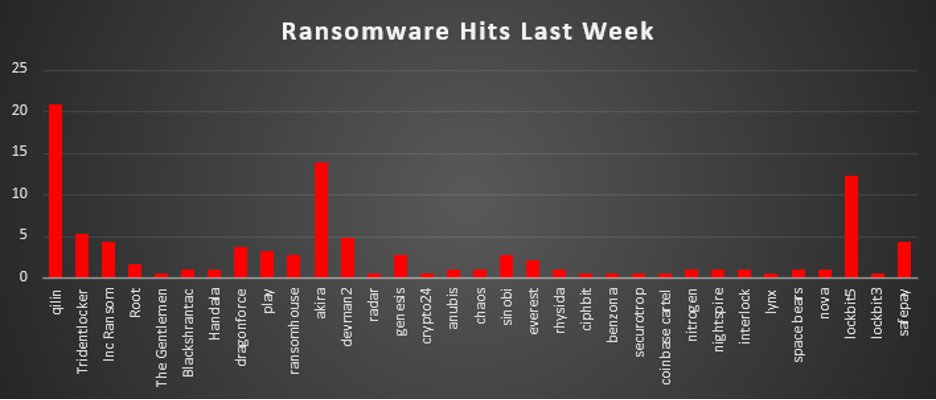
The Red Piranha Team conducts ongoing surveillance of the dark web and other channels to identify global organisations impacted by ransomware attacks. In the past week, our monitoring revealed multiple ransomware incidents across diverse threat groups, underscoring the persistent and widespread nature of these cyber risks. Presented below is a detailed breakdown of ransomware group activities during this period. Ransomware Victims – Weekly OverviewQilin led this week’s activity, responsible for 20.86% of all reported incidents. This made it the single most dominant operator in the ecosystem, suggesting a concentrated campaign window or a bulk release of victim disclosures that put Qilin clearly ahead of every other group. A powerful second tier was formed by Akira (13.9%) and LockBit 5 (12.3%), both continuing to operate as large, mature ecosystems with steady victim intake and multi-region targeting. TridentLocker (5.35%) sat just behind them, indicating an increasingly relevant presence and hinting at a growing pipeline of compromises. A mid-tier cluster, DevMan2 (4.81%), Inc Ransom (4.28%), SafePay (4.28%), DragonForce (3.74%), Play (3.21%), RansomHouse (2.67%), Genesis (2.67%), Sinobi (2.67%), and Everest (2.14%), maintained a steady operational tempo. These crews collectively contributed a substantial share of cases, combining data theft, double extortion, and opportunistic intrusions across multiple industries. Smaller but persistent operators, including Root (1.6%), alongside BlackShrantac, Handala, Anubis, Chaos, Rhysida, Nitrogen, Nightspire, Interlock, Space Bears, and Nova (each 1.07%), sustained a low- to mid-volume presence. Their activity reflects ongoing campaigns that may not dominate headlines individually but keep the overall pressure high across regions and sectors. At the long tail, low-frequency brands such as The Gentlemen, Radar, Crypto24, Ciphbit, Benzona, Securotrop, Coinbase Cartel, Lynx, and LockBit 3 (each 0.53%) appeared only sporadically but still contributed to ecosystem fragmentation and churn. While each represents a small fraction of total incidents, their combined footprint underscores how diversified and resilient the ransomware landscape remains. |
LockBit 5.0
LockBit 5.0 is the newest iteration of the long-running LockBit RaaS operation and represents a major upgrade rather than a simple version bump. First seen in September 2025, this version expands LockBit’s cross-platform focus with hardened payloads for Windows, Linux, and ESXi, supported by a more stealth-capable loader and extensive anti-analysis mechanisms.
The malware uses heavy packing, encrypted strings, dynamic API hashing, and process hollowing to avoid EDR visibility. Its two-stage execution model, where a loader injects the encryptor into defrag.exe, allows near fileless deployment, making detection significantly harder. LockBit 5.0 also patches ETW logging, reloads clean copies of system DLLs to defeat EDR hooks, and kills over 60+ security and backup services during execution.
Encrypted files receive a random 16-character extension, making automated recovery more difficult. The ransomware drops a ransom note (typically ReadMeForDecrypt.txt) directing victims to Tor negotiation portals and the LockBit leak site. This version continues to avoid execution on Russian / CIS language systems, consistent with LockBit’s origin.
LockBit 5.0’s resurgence follows the gang’s internal leak in early 2025 and law-enforcement pressure under Operation Cronos. Despite setbacks, this version demonstrates the group’s enhanced technical sophistication, faster encryption engine, and a more aggressive affiliate ecosystem.
Detailed TTPs (Short)
Initial Access
- Delivered by affiliates via phishing, unpatched public-facing apps, or compromised RDP/VPN credentials.
- Attackers establish persistence, escalate privileges, then manually deploy the payload.
Execution & Payload
- Two-stage loader injects the encryptor into defrag.exe for stealthy execution.
- Supports invisible/visible modes, selective encryption, delays, and network-wide targeting.
- Uses XChaCha20 + Curve25519 for fast and strong encryption across Windows, Linux, and ESXi.
Privilege Escalation & Lateral Movement
- Affiliates dump credentials (LSASS/SAM) using Mimikatz, ProcDump, or built-in Windows utilities.
- Spread using PsExec, SMB admin shares, PowerShell remoting, WMI, or GPO startup scripts.
Defence Evasion
- Packed/obfuscated loader, encrypted strings, dynamic API hashing.
- Unhooks security DLLs, patches ETW to kill event logging, deletes shadow copies, wipes logs.
- Skips Russian/CIS systems based on locale.
Collection & Exfiltration
- Uses StealBit or Rclone to exfiltrate sensitive data before encryption.
- Large outbound HTTPS/uploads to attacker infrastructure or cloud storage.
Impact
- Encrypts local and network data; ESXi variant can knock out entire VM clusters.
- Appends random 16-char extensions; drops ReadMeForDecrypt.txt.
- Deletes backups, shadow copies, and disables security tools to maximise impact.
MITRE ATT&CK TTP Matrix
Tactic | Technique | ID | Summary |
Initial Access | Phishing, Exploit Public-Facing Apps, Valid Accounts | T1566 / T1190 / T1078 | Affiliates use emails, vulnerable VPN/servers, or stolen RDP/VPN creds. |
Execution | PowerShell/MSHTA, Process Hollowing (defrag.exe) | T1059 / T1055.012 | Fileless loader injects encryptor into trusted processes. |
Persistence | None (operationally deployed once) | — | Attackers persist manually; LockBit itself doesn't. |
Privilege Escalation | Credential Dumping, Valid Accounts | T1003 / T1078 | LSASS/SAM dump → domain admin → mass deployment. |
Defence Evasion | Obfuscation, API Hashing, Unhooking, ETW Patch, Kill Security Tools | T1027 / T1562 | Loader heavily obfuscated; system telemetry disabled. |
Credential Access | LSASS dumping | T1003 | Tooling used pre-deployment for lateral movement. |
Discovery | Network Share Discovery | T1135 | Prepare for broad encryption. |
Lateral Movement | PsExec, WMI, SMB | T1021 / T1047 | Rapid spread across domain. |
Collection | Data staging before exfiltration | T1560 | Archives created pre-encryption. |
Exfiltration | Rclone / StealBit to cloud or attacker infra | T1567 | Data stolen for double extortion. |
Impact | Encrypt Data, Inhibit Recovery | T1486 / T1490 | XChaCha20 encryption + deletion of backups. |
Indicators of Compromise (IOCs)
Malware Hashes
Known LockBit 5.0 samples include:
- 7ea5afbc166c4e23498aa9747be81ceaf8dad90b8daa07a6e4644dc7c2277b82
- 180e93a091f8ab584a827da92c560c78f468c45f2539f73ab2deb308fb837b38
- 4dc06ecee904b9165fa699b026045c1b6408cc7061df3d2a7bc2b7b4f0879f4d
- 90b06f07eb75045ea3d4ba6577afc9b58078eafeb2cdd417e2a88d7ccf0c0273
- 98d8c7870c8e99ca6c8c25bb9ef79f71c25912fbb65698a9a6f22709b8ad34b6

Ransom Notes
- ReadMeForDecrypt.txt

File Extensions
- Random 16-character extensions (unique per infection).
Onion Infrastructure
- LockBit 5.0 Support/Chat:
lockbitsuppyx2jegaoyiw44ica5vdho63m5ijjlmfb7omq3tfr3qhyd.onion - Affiliate Panel:
lockbitfbinpwhbyomxkiqtwhwiyetrbkb4hnqmshaonqxmsrqwg7yad.onion

- Leak Site:
lockbitapt67g6rwzjbcxnww5efpg4qok6vpfeth7wx3okj52ks4wtad.onion - Data Storage Server:
lockbitfss2w7co3ij6am6wox4xcurtgwukunx3yubcoe5cbxiqakxqd.onion

Tox
3085B89A0C515D2FB124D645906F5D3DA5CB97CEBEA975959AE4F95302A04E1D14E41080A105
Crystal Eye 5.5 Mitigation
- Secure External Access
- Enforce MFA on RDP/VPN; patch exposed apps; block legacy protocols.
- Privilege Management
- Rotate admin/MSP creds; disable unused accounts; monitor privilege escalation in CE SIEM.
- Backup & Recovery Protection
- Use offline/immutable backups; restrict access to backup servers; detect shadow-copy deletion.
- Execution Control
- CEASR: block unknown binaries from %TEMP%, %APPDATA%; restrict PsExec and WMI remoting.
- Exfiltration & Tor Detection
- Monitor large outbound uploads; block Tor entry nodes and LockBit Onion domains.
- Endpoint Hardening
- Enable EDR tamper protection; enforce Sysmon-style logging; monitor suspicious defrag.exe behaviour.
- Network Segmentation
- Isolate AD, ESXi hosts, file servers, and critical infra.
- IR Playbook
- Automate SOAR actions for LockBit IOCs; isolate hosts; block hashes/Onion URLs; rotate credentials.
Ransomware Victims Worldwide
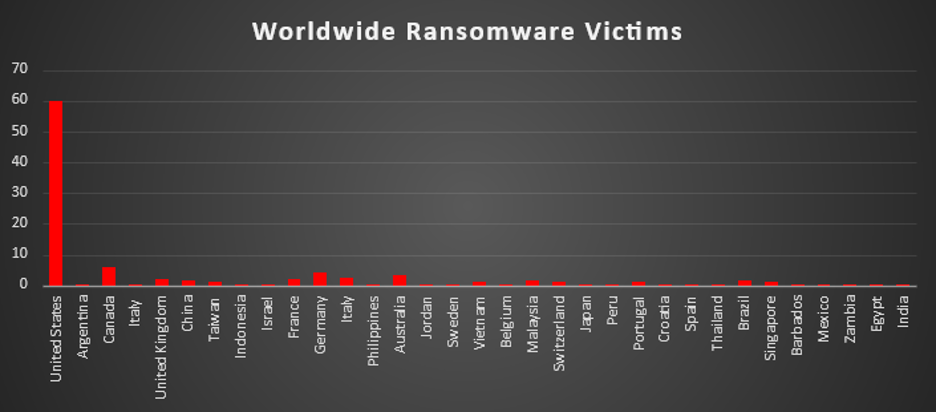
The United States overwhelmingly dominated this week’s ransomware landscape, accounting for 59.89% of all identified victims. This level of concentration again confirms that the US is the primary hunting ground for most major ransomware operations, driven by its large enterprise footprint, higher disclosure rates, and the perceived willingness/ability of victims to pay.
Canada (5.88%) emerged as the second most impacted country, placing it firmly behind the U.S. but still in a clearly high-risk bracket. Together, the US and Canada represented over 65% of all observed victims, underlining how strongly threat actors continue to prioritize North American targets.
A notable mid-tier group included Germany (4.28%), Australia (3.21%), and Italy (combined 3.20%), followed by France and the United Kingdom (each 2.14%). These mature economies consistently appear in victim datasets, reflecting both sizable digital infrastructures and regular reporting of incidents.
Below this, a broader band of activity was seen across China, Malaysia, and Brazil (each 1.60%), with Taiwan, Vietnam, Switzerland, Portugal, Singapore (each 1.07%), and Newer single-digit presences like Argentina, Indonesia, Israel, Philippines, Jordan, Sweden, Belgium, Japan, Peru, Croatia, Spain, Thailand, Barbados, Mexico, Zambia, Egypt, and India (each 0.53%) forming the long tail. While these countries show relatively low individual volumes, their combined footprint reinforces a key trend: ransomware remains a global problem, with opportunistic and campaign-driven attacks touching almost every region rather than being confined to a small set of geographies.
Industry-wide Ransomware Victims
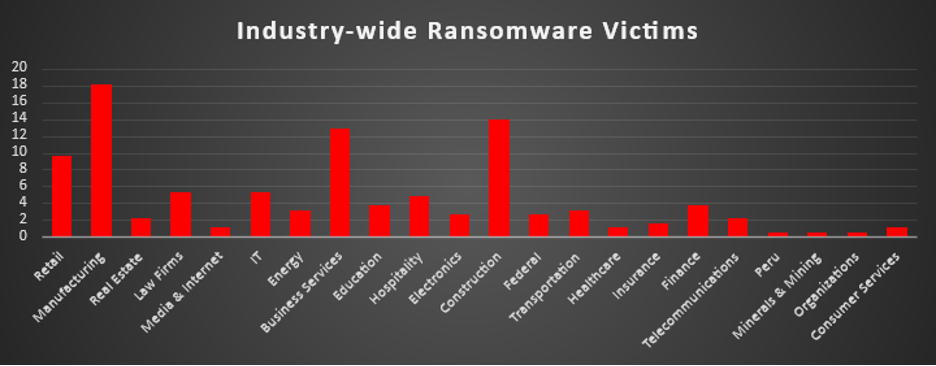
Manufacturing remained the most heavily targeted sector this week, accounting for 18.18% of all identified ransomware victims. This keeps it firmly at the top of the risk ladder, reflecting how production-critical environments and supply-chain dependencies continue to make manufacturers highly attractive extortion targets.
A strong second tier was formed by Construction (13.9%), Business Services (12.83%), and Retail (9.63%). Together, these industries represent a broad mix of project-driven, service-oriented, and consumer-facing organisations, all of which handle high-value contracts, payments, and operationally sensitive timelines that ransomware operators routinely exploit to increase leverage during negotiations.
A diverse mid-band followed with Law Firms and IT (each 5.35%), Hospitality (4.81%), Education and Finance (each 3.74%), and Energy and Transportation (each 3.21%), supported by Electronics and Federal entities (each 2.67%), as well as Real Estate and Telecommunications (each 2.14%). This layer underscores that both private and public sectors — from legal and professional services to infrastructure, government, and critical business operations — remain regular fixtures in victim disclosures.
Lower-volume but still active verticals included Insurance (1.6%), and Media & Internet, Healthcare, and Consumer Services (each 1.07%), with Minerals & Mining and general Organisations (each 0.53%) forming the long tail. While individually small, this distribution shows that ransomware activity is not confined to a handful of headline sectors; nearly any industry with digitised operations and monetisable data remains within the threat envelope. (One entry labelled “Peru” appears to be a misclassified data point and is not treated as a separate industry in this breakdown.)